The June Writers Academy Blog
Your guide to supporting your child’s development as a writer and thinker.


Parent Tip: Lesson 2.5
How to help your child read the epic poems featured in Lesson 2.5: Greek & Latin Roots 2.

Parent Tips: Lesson 2.2
Lesson 2.2: Themes & Reasoning focuses on developing foundational analytical skills. We teach kids to notice different types of themes in texts and then to think deeply about why those themes might be in that particular text.
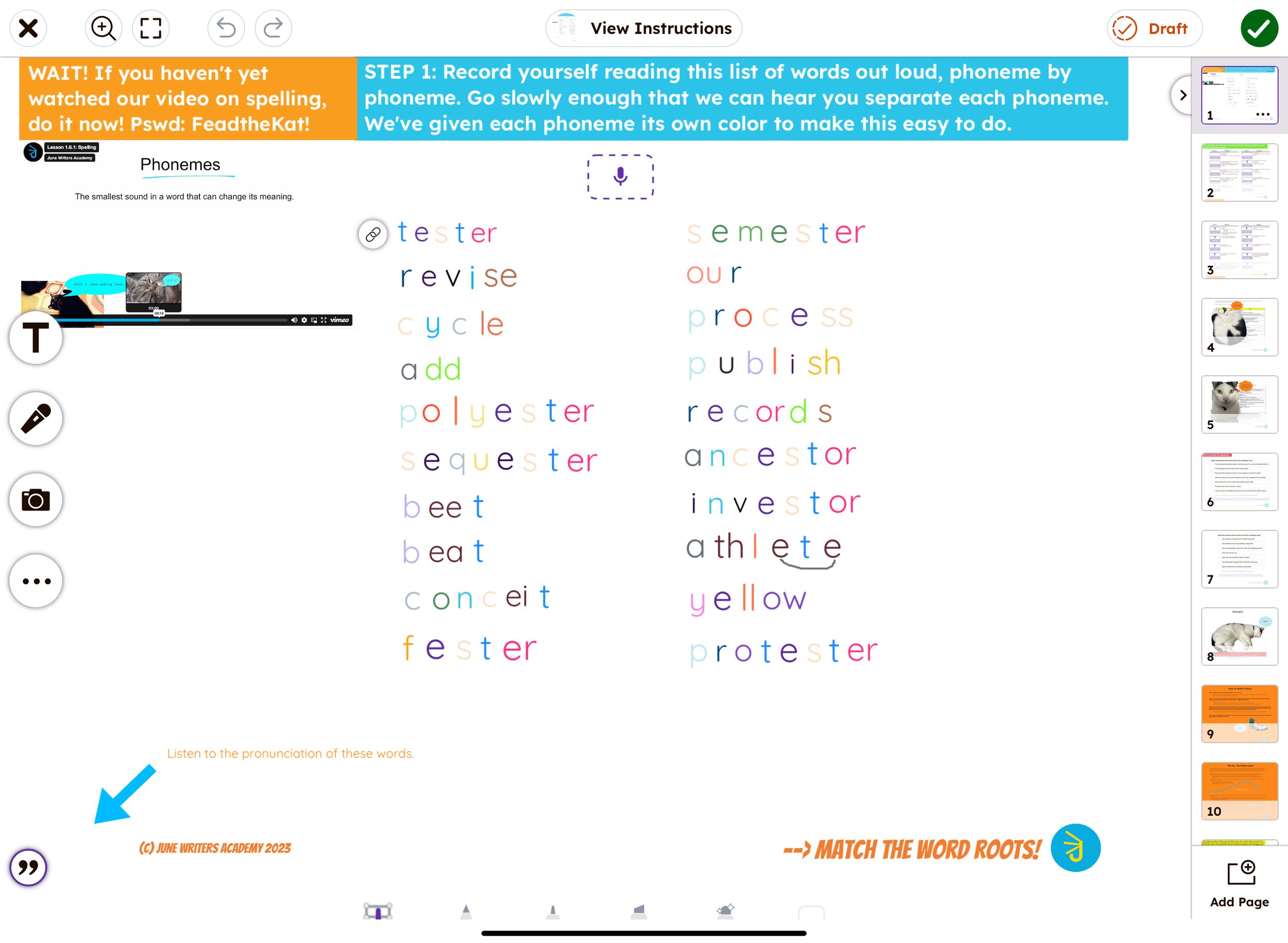
Sample Practice: Spelling
How does June Writers teach spelling? See an example practice from Level 2.

Parent tip: Erratic verb tense and your child’s wild mind
What to do when your child’s writing doesn’t follow linear time conventions.

The layers of an argument
We’ve written before about the importance of teaching kids to write multi-layered arguments early in their development process. Writing three-layered arguments is the key work of our Level 2: Argument Foundation program, but most kids and adults don’t immediately understand what this means—or what it looks like. So, here is a breakdown of what the different layers look like when it comes to kids’ writing.

Outline or bubble map? Which is better?
Adults can have strong feelings about the best way to teach kids to write. A surprising number of us wax poetic for hours about the joy of sentence diagramming, while an equal number are driven to drink by the memory. Some adults believe outlines are the only way to organize thoughts in the pre-writing stage, but others are fine with outlining or bubble maps. (And a shocking number don’t make a habit of organizing their thoughts before they write.) So, what is the best way to teach kids to write?

Parent Tips: Practice 2.8.2
Some kids will be able to dive right into writing paragraphs by Lesson 2.8. (Note that we will have asked your child to spend extra time on extension practices for Lesson 2.4 if we thought they needed more practice on paragraph writing basics before they moved on to Lesson 2.5+.) Others will need to use part or all of the scaffolding sequence we taught in Lesson 2.3, Lesson 2.4, and Lesson 2.7 to complete Lesson 2.8. That’s OK!

Parent Tips: Lesson 2.1
Lesson 2.8 is about writing paragraph content in chronological order, but it’s also about teaching kids to think about the best ways to organize their thoughts.

Parent Tips: Lesson 2.8
Lesson 2.8 is about writing paragraph content in chronological order, but it’s also about teaching kids to think about the best ways to organize their thoughts.

Sample Practice: Level 2
In Practice 2.3.3: Creating Argument Sentences, we teach kids to build argument sentences that already contain two layers of thought.

Parent Tips: Lesson 2.10
The idea that we write differently in different situations is a Big Brain Leap, and a key concept for ensuring that your child becomes flexible writer, able to adapt to different writing situations with ease.
Parent Tips: Lesson 2.9
Most kids learn opinion writing very early in their school career because kids love telling people how they think the world should work.

Parent Tips: Lesson 2.4
This is the big moment! Even if your child is used to writing paragraphs or essays at school, it is unlikely they’ve ever been asked to build an argument around a complex thought process.
Parent Tips: Practice 2.3.4
Practices 2.3.4 and 2.3.5 ask kids to analyze how writers connect ideas in a paragraph.
Parent Tips: Practices 2.3.2 & 2.3.3
Practices 2.3.2 and 2.3.3 are Big Brain Leaps. Your child will be asked to make connections among ideas, and then clearly state common themes.

Parent Tips: Practices 1.1.3 & 2.1.2
It may be difficult for some children to tap into their full creativity, particularly since we are asking them to think of gentle insults, not mean insults.